Updated: December 2025
Where: 1385 English Street NW, Atlanta, Georgia 30318
Teatimes: Monday 1 to 4; Tuesday, Thursday, Friday 1 to 6:30; Saturday, Sunday 10 to 6:30; **Free Monday community tea sessions, walk-ins welcome, 6 to 7:30 pm**
Contact: Reserve here, 404-698-3172
Cost: $25 – $50 Gong Fu Tea Experience (one hour, includes 3 teas)
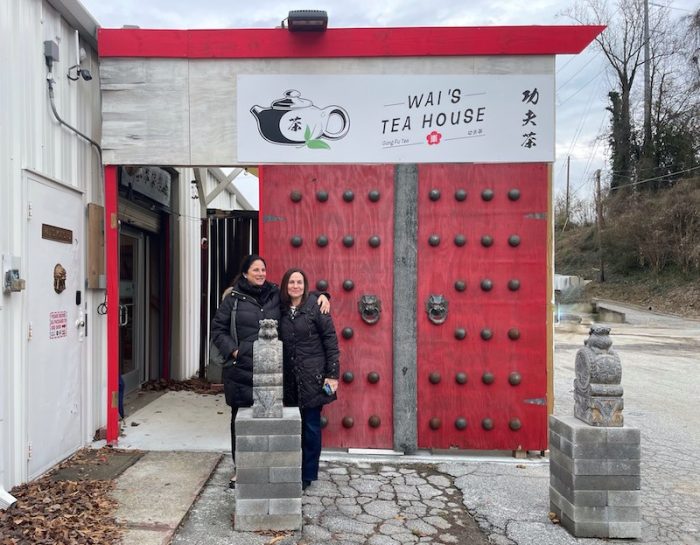
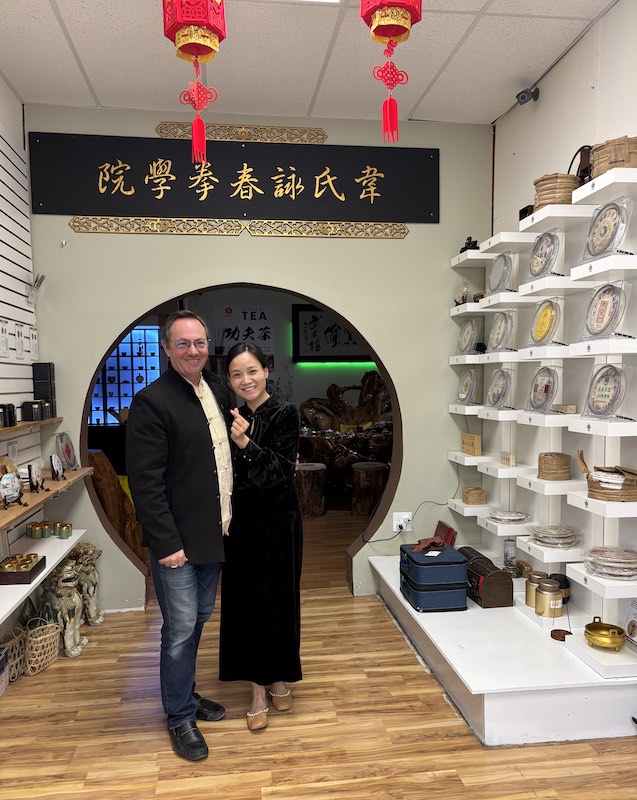
In 2023, husband-and-wife Wayne and Amy Belonoha opened Wai’s Tea House in Atlanta’s Westside, touted as Georgia’s only gong fu teahouse. Born and raised in Huang Shan (Yellow Mountain), China, Amy wanted to share the region’s renowned green teas with others. Originally from Canada, Wayne began his tea journey while studying Wing Chun kung fu in China. Now “Sifu Wayne,” (pronounced “see-foo” or “she-foo” and meaning “teacher”) is the head instructor of Wai’s Kung Fu martial arts school, which shares the space with Wai’s Tea House. Both Amy and he lead guests through a traditional 21-step Gong Fu Cha (tea), tea tastings, and brewing 101 classes. Since our first visit two years ago, we have returned four more times, introducing more and more of our tea friends to the joys of the highest quality whole leaf tea, brewed properly.


Gong Fu vs. Western Brewing Methods
The biggest takeaway for Destination Tea readers is that the Chinese method of brewing tea uses four times the amount of tea leaves as the Western method (see our math below). This obviously creates a much stronger brew. How will your experience of the tea be different in the Gong Fu style?

- Tea leaves are steeped for seconds, not minutes, preventing an astringent brew.
- The first brew is discarded, called a rinsing of the leaves, so that the first tea served is made with leaves that have begun opening, imparting maximum flavor.
- Tea leaves are always steeped free-floating in the vessel, so that they may completely open and infuse full flavor into each brew.
- Tea leaves are resteeped an average of 5 to 10 times, each brew slightly different but still flavorful.
- Smaller tea cups are constantly refilled with hot tea so there’s no need to keep a teapot warm, but there is a repeated need for freshly boiled water for resteeps throughout the teatime.
- Sugar and milk are nowhere to be found, as we are appreciating the delicious essence of the pure tea.


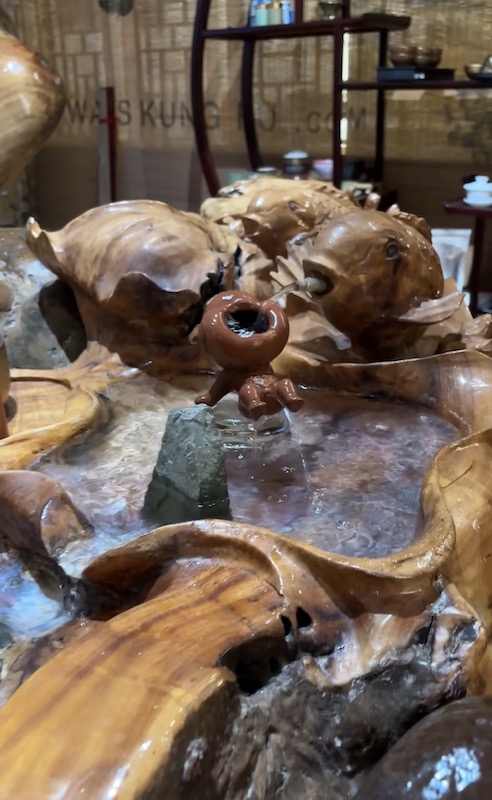

As he prepares and serves tea, Sifu Wayne patiently answers our barrage of questions. He explains that “gong fu” is a uniquely Chinese word that refers to any “artful skill developed through patient investment.” Regarding tea preparation, it indicates that “special effort and dedication is made by your host to maximize the taste, aroma and appearance” of the tea served. But here’s the best part:
Gong fu tea is used to self-cultivate, meditate and provide an experience that heals a special guest’s body and mind.”
– Wai’s Tea House, Atlanta
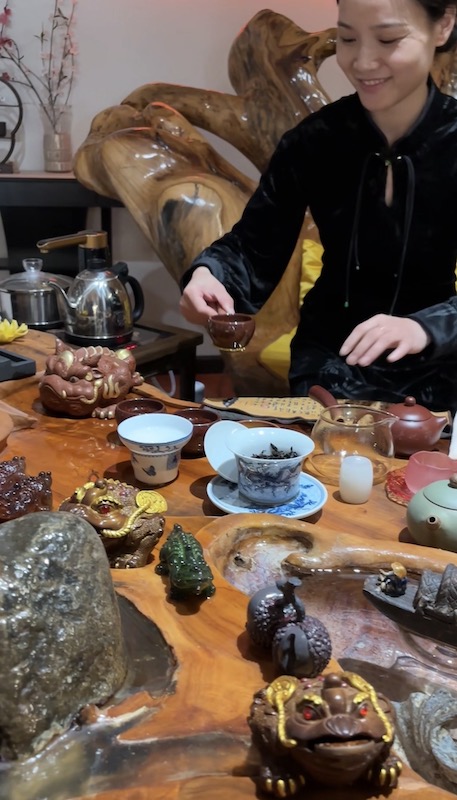
We equally enjoy our time with Amy on subsequent visits. She emphasizes the balancing and healing properties of tea, especially of fresh green tea leaves, such as the Dragon Well long jing green tea we try. She clearly derives pleasure from watching her guests happily sip and smile over the teas she serves, telling us, “I see four little girls here.” She points out the different brews created by broken tea leaves and tea dust in tea bags, versus whole leaf teas.
We call tea bags ‘tea hot dogs.’
– Amy of Wai’s Tea House
When you watch the quick tutorial on Gong Fu tea preparation below (thank you Jesse’s Teahouse), you’ll see that experiencing Gong Fu Cha at Wai’s Tea House adds a level of beauty and ceremony to the tasting.
Gong Fu Tea at Wai’s Tea House
The Gong Fu Tea Experience is an hour-long session during which you will try multiple infusions of three teas you select. We’ve tried buttery oolongs, fresh greens, smoky red teas and rock puerhs (“poo-ahr”), amongst others, always finding a new favorite to take home. We recommend taking full advantage of your visit here to expand your tea palate and stock up on whole leaf teas.
During our time together, Wayne described the different processing methods that create the various tea varieties. He taught us how to “give face” to others and show your own humility throughout the tea tasting, using the secret language of tea table etiquette. He introduced us to the special properties of Jian Zhan teacups, handmade from high-iron clay, each one uniquely glazed. Their high-iron content and firing at a high temperature make these teacups retain your tea’s warmth longer, and can smooth the texture and sweeten the taste of your tea.


On a return visit, Wayne kindly brewed a tea coin we had been gifted, to demonstrate the difference in quality of teas.
On the martial arts side of the house, a Wing Chun Sword Experience is offered, reminding us that Sifu Wayne began his tea education while living in China for kung fu training.


Can We Ever Steep the Same Again?
We cannot ignore the beautiful and changing tastes of our teas at Wai’s Tea House, as we sampled infusion after infusion of the very same tea leaves. The Western method of brewing a much smaller amount of tea leaves in a big teapot clearly does not deliver the full flavor profile of the tea. Likely, this method was originally developed in non-tea-producing countries because imported teas from China were so expensive — trying to make a little go a long way. Then they added milk and sugar to improve the taste. Anyone having tasted a Gong Fu Cha (tea) knows how delicious a quality tea is, without these condiments.

However, at afternoon tea, the serving custom is different. A hostess prepares the three courses of food and aims to serve these with a hot pot of tea upon guests’ arrival. Then it’s time to luxuriate and enjoy the meal and conversation. She does not continually resteep tea throughout the afternoon. Tea cosies and teapot warmers are used to keep beautiful teapots warm. Larger bone china teacups, though delicate and lovely in their design, hold more tea than Gong Fu tasting cups, allowing tea to begin to cool before a guest can empty her cup.
The Gong Fu style of brewing is very doable for oneself at home. Though you may go through your tea supply more quickly using the Gong Fu tea to water ratio, also consider that you can resteep that loose leaf tea all day long, rather than going through 2 or 3 teabags every day. If you want to prepare a mug of tea for yourself, you can do so using the gong fu method. The quick 15 or 30 second steeps allow you to make two or three infusions in a row while water is still at temperature, combining to fill your mug.
But what about at a traditional afternoon tea? We might just splurge on the larger quantity of good tea so that our guests get the full pleasure of the tea brewed with the Gong Fu tea to water ratio. To get your money’s worth, you could steep and decant three or four infusions ahead of time (remember to toss the first one, which is only meant to bloom the tea leaves, not to drink). Then just keep the brewed tea to temperature on warmers or on the stove, and you have multiple pots of a rich brew ready to serve. You could take your remaining tea leaves and cold brew them overnight to get even more delicious tea from your purchase. How would you do it, to make excellent tea a feature of your afternoon tea experience?


